
Nullam dignissim, ante scelerisque the is euismod fermentum odio sem semper the is erat, a feugiat leo urna eget eros. Duis Aenean a imperdiet risus.

Get Appointment

Plan your Andaman holiday with local experts based in Port Blair

  • Rangat
  • Dhani Nallah Mangrove Walkway

Middle Andaman's Mangrove Experience, Boardwalk Through Andaman Islands' Tidal Forest

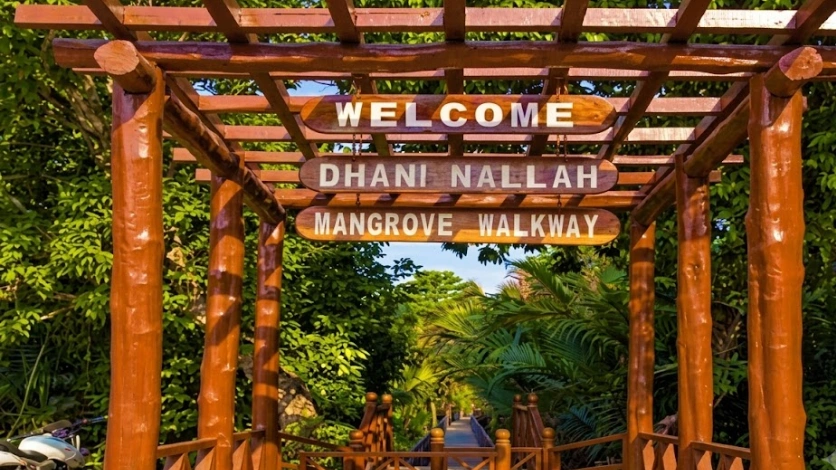
Dhani Nallah Mangrove Walkway is a raised wooden boardwalk built through a dense mangrove forest on the creek edge near Rangat, approximately 7 kilometres from Rangat town on the road toward Amkunj Beach. The walkway extends into the heart of the mangrove system, passing over tidal channels, root networks, and the extraordinarily complex intertidal ecology that makes mangrove forests one of the most productive natural environments on earth. Most visitors to the Andamans see mangroves from a distance, from a ferry deck, from a road bridge, from a boat on the creek. Dhani Nallah puts you inside one. The canopy closes overhead, the tidal mud is visible a metre below the boardwalk, the aerial roots of Rhizophora and Avicennia rise in dense tangles from the water, and the birdlife, kingfishers, herons, mudskippers moving across the exposed root surfaces, crabs working the tidal channels, is active and close. It is one of the most genuinely educational natural experiences available anywhere in the Andaman archipelago, and it is free to enter.

Dhani Nallah Mangrove Walkway Rangat Middle Andaman - raised wooden boardwalk tidal forest creek Andaman Islands

About Dhani Nallah Mangrove Walkway, Inside Middle Andaman's Tidal Forest

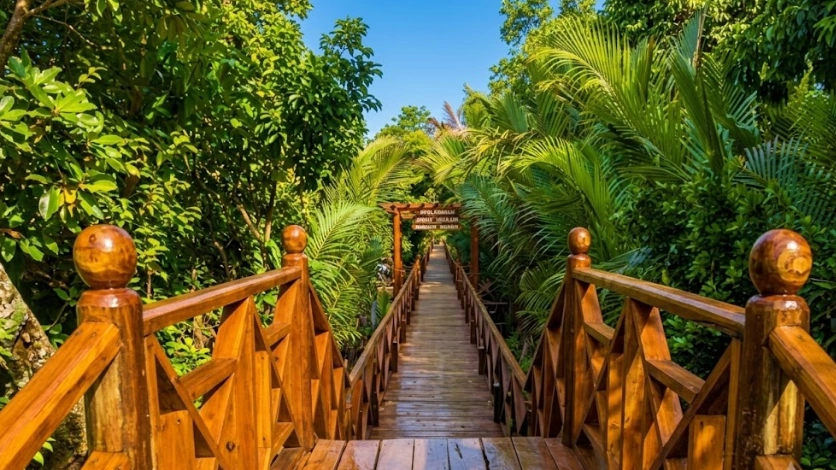
Dhani Nallah is a tidal creek system on the eastern coast of Middle Andaman, fed by the Bay of Bengal and flanked by one of the most intact mangrove forest stands in the Rangat subdivision. The walkway, constructed and maintained by the Forest Department of Andaman and Nicobar Islands, runs on raised wooden planking above the tidal zone, allowing visitors to move through the mangrove interior without disturbing the root systems or the mud surface below. The structure is designed to be passable at all tide states, though the experience changes significantly depending on whether you arrive at high tide, when the water rises around the pneumatophore roots, or low tide, when the full complexity of the tidal mud and its inhabitants is exposed.

The mangrove species present at Dhani Nallah include Rhizophora apiculata and Rhizophora mucronata (stilt-rooted mangroves), Avicennia marina and Avicennia officinalis (grey mangroves with pencil-like pneumatophores), Bruguiera gymnorrhiza (with distinctive knee roots), and Sonneratia species along the creek channel edges. This species diversity is higher than at most publicly accessible mangrove sites in the Andamans and reflects the relatively undisturbed condition of the Dhani Nallah creek system. The Forest Department signboards along the walkway identify the major species, making it a practical introduction to mangrove ecology for visitors with no prior background.

The walkway is short, approximately 400 to 500 metres in length, but the density of what it passes through makes a slow walk of 45 minutes to an hour entirely worthwhile. The tidal creek is visible from several points along the route, and the change in light as you move deeper into the canopy, from open sky to a green filtered overcast of interlocking branches, is one of the more disorienting and memorable transitions in any Andaman natural site. Early morning visits, when the birdlife is most active and the light comes in low and green through the canopy, are strongly recommended.

Dhani Nallah puts you inside the mangrove rather than beside it. The tidal mud, the root systems, the creek channels, and the birdlife are all within arm's reach from the boardwalk. There is nothing comparable to it in the southern Andamans.

The History of Dhani Nallah Mangrove Walkway

The Andaman and Nicobar Islands contain approximately 700 square kilometres of mangrove forest, representing one of the largest and most ecologically intact mangrove systems in India. The islands' mangroves were historically used for timber, mangrove wood, particularly from Rhizophora species, was harvested for construction, fuel, and charcoal production during the British colonial period and continued into the post-independence era. Rangat subdivision, with its extensive creek systems along the eastern Middle Andaman coast, was part of this extraction history.

The Dhani Nallah creek system was among the mangrove areas that came under Forest Department protection as conservation awareness of mangrove ecology increased from the 1980s onward. Recognition of mangroves as critical nursery habitat for fish and crustaceans, as coastal protection against storm surge and erosion, and as significant carbon sinks, mangroves sequester carbon at rates several times higher than terrestrial forests, shifted management policy from extraction toward preservation across much of the Andaman archipelago. The Dhani Nallah mangrove stand benefited from this shift and remained largely intact while mangrove cover declined in more accessible and commercially pressured areas.

The Forest Department constructed the raised boardwalk at Dhani Nallah as part of an eco-tourism development initiative for the Rangat subdivision, intended to create a low-impact visitor experience that would generate local awareness of mangrove ecology without causing physical damage to the root systems and tidal mud below. The boardwalk design, elevated above the tidal zone on wooden piles, was specifically chosen to allow the full range of tidal movement beneath it without interruption. Interpretive signboards identifying mangrove species and explaining tidal forest ecology were installed along the route as part of the same initiative.

The walkway has required periodic maintenance and repair since its construction, as the tidal and humid environment of a mangrove forest is hard on wooden structures. The Forest Department range office in Rangat manages the site. Access has remained free of charge throughout, reflecting the department's approach to the site as a public education resource rather than a revenue-generating attraction. The combination of free access, genuine ecological interest, and proximity to Rangat town has made Dhani Nallah the most consistently recommended natural stop in the Rangat subdivision for independent travellers passing through on the Andaman Trunk Road.

Plan Your Dhani Nallah Visit with Our Local Experts

What to See and Do at Dhani Nallah

Dhani Nallah is not a managed tourist attraction with scheduled activities. It is a boardwalk through a living tidal forest. The experience depends entirely on when you arrive, how slowly you move, and how much attention you pay to what is happening in the root systems, the mud, and the canopy around you.

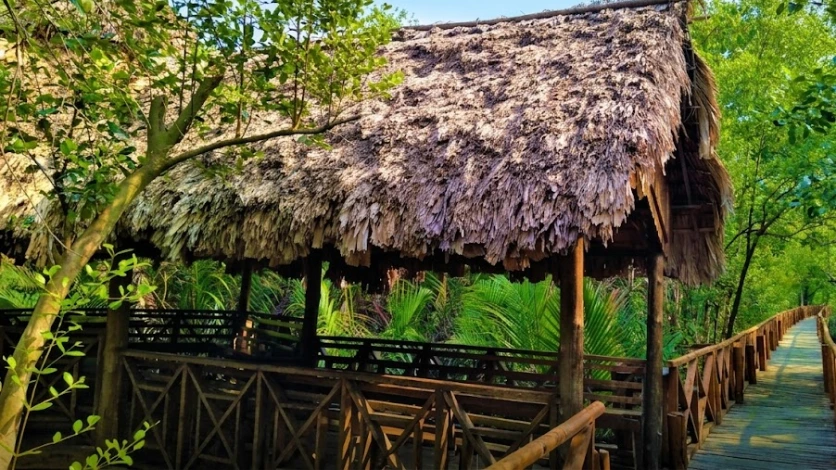
Dhani Nallah Mangrove Walkway Rangat Andaman - boardwalk tidal creek Rhizophora roots birdwatching Middle Andaman

Mangrove Ecology Walk

The boardwalk passes through a multi-species mangrove stand where Rhizophora, Avicennia, Bruguiera, and Sonneratia species are all present within a short distance of each other. The Forest Department signboards along the route identify each species and explain the adaptive strategies, stilt roots, pneumatophores, knee roots, vivipary, that allow mangroves to survive and reproduce in anaerobic tidal mud. For travellers with an interest in natural history or ecology, Dhani Nallah is the most concentrated educational resource on mangrove biology available anywhere in the Andamans. For those with no prior background, the signboards are clear enough to make the walk genuinely informative without prior preparation. Walking slowly, reading each board, and spending time observing the root systems and the tidal channel below takes about an hour and covers more ground than most half-day boat mangrove tours offered elsewhere in the Andamans.

Birds of the Mangroves

The mangrove forest at Dhani Nallah supports a bird population that is active throughout the day but most concentrated in the two hours after sunrise. Common kingfisher, collared kingfisher, and white-throated kingfisher are all regularly observed hunting from the exposed roots and low branches over the tidal channels. Grey heron and little egret work the mud flats at low tide. Striated heron, a compact, cryptically coloured species that hunts from the root tangles rather than in open water, is present and easy to miss without careful observation. Mangrove whistler and mangrove pitta have both been recorded in the Dhani Nallah forest, though the pitta requires patience and good fortune. Mudskippers, amphibious fish that move across the exposed mud and root surfaces at low tide, are among the more unusual inhabitants of the intertidal zone and are easily visible from the boardwalk when the tide is out.

Exploring Tidal Creeks

Dhani Nallah offers two distinct experiences depending on the state of the tide when you visit, and both are worth experiencing if your itinerary allows a second visit. At high tide the water rises around the pneumatophore roots of the Avicennia trees and the stilt roots of the Rhizophora, submerging the lower tidal zone entirely and creating the impression of a forest growing directly from the sea. The creek channels widen and deepen, small fish move through the root systems feeding on the invertebrates that live there, and the overall effect is of an aquatic forest. At low tide the full complexity of the tidal mud is exposed, mudskippers, fiddler crabs, mangrove crabs, and various wading birds all become active simultaneously on a surface that was completely underwater an hour earlier. Checking the tide table before your visit and choosing your preferred experience is worthwhile.

Rangat's Natural Attractions

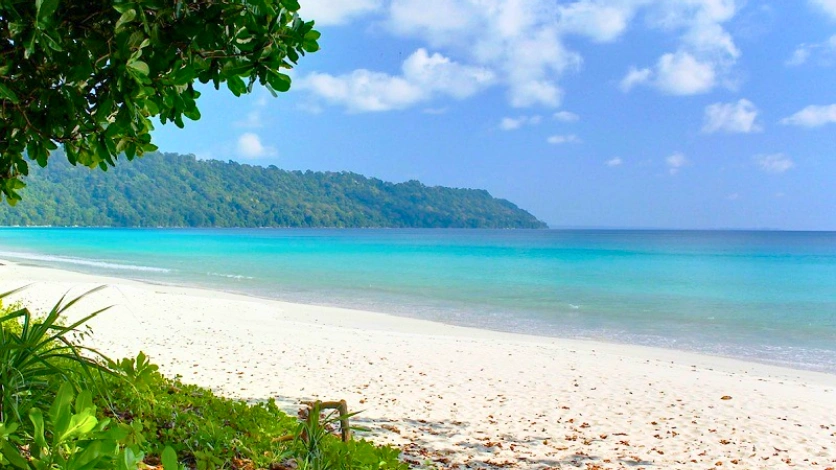
Dhani Nallah sits on the road between Rangat town and Amkunj Beach, making it a natural addition to the Rangat day circuit without any detour. A practical sequence: Amkunj Beach at sunrise for the tidal flat reflection, Dhani Nallah Mangrove Walkway mid-morning when the birdlife is still active and the light is good in the canopy, and Cuthbert Bay Beach in the late morning for the Forest Department sea turtle hatchery and the beach itself. The full circuit covers three entirely different natural environments, open tidal beach, mangrove forest interior, and sea turtle nesting shore, in a single half-day out of Rangat, and the route involves no backtracking. Our team includes this circuit in all Middle Andaman itineraries as the most efficient way to cover what Rangat actually offers.

Dhani Nallah Mangrove Walkway Rangat Middle Andaman - tidal creek canopy boardwalk Avicennia Rhizophora roots

Dhani Nallah Mangrove Walkway Visitor Information

Location Dhani Nallah creek, approximately 7 km from Rangat town on the road toward Amkunj Beach; Middle Andaman Island; 174 km north of Port Blair via Andaman Trunk Road
How to Reach Rangat By road from Port Blair via Andaman Trunk Road (approximately 4 to 5 hrs, passing through Baratang creek crossings by ferry barge). Government bus services run daily. From Rangat town, reach Dhani Nallah by hired two-wheeler, auto-rickshaw, or jeep in approximately 15 to 20 minutes
Best Time to Visit October to May. Early morning (6:30 to 9:00 AM) for birdwatching and canopy light. Low tide mornings for mudskippers, crabs, and the full intertidal zone. High tide visits for the submerged root experience. Avoid June to September (monsoon, boardwalk may be partially damaged or closed)
Ideal Visit Time Sunrise to 9:00 AM for birdwatching. Any daylight hour for the mangrove walk itself. Check tide tables, low tide reveals the intertidal ecology; high tide gives the aquatic forest effect. Both are worth experiencing
Key Attractions Multi-species mangrove forest interior, raised boardwalk over tidal channels, Forest Department species identification signboards, kingfisher and heron birdwatching, mudskippers and fiddler crabs at low tide, tidal creek observation, mangrove ecology education
Entry Fee Free entry. No ticketing, no booking required. Forest Department managed site. Open during daylight hours. Verify current access status with Rangat Forest Range Office before visiting as boardwalk maintenance closures occur periodically
Mangrove Species Present Rhizophora apiculata, Rhizophora mucronata, Avicennia marina, Avicennia officinalis, Bruguiera gymnorrhiza, Sonneratia species. Species identification boards installed along the walkway route
Facilities Available Forest Department signboards along the route. No food, water, or shade facilities at the site. Carry water and insect repellent from Rangat town. Basic accommodation and restaurants available in Rangat (7 km)
Nearby Attractions Amkunj Beach (approx. 1 km further on the same road), Cuthbert Bay Beach and turtle hatchery (approx. 4 km from Rangat), Rangat town market, Moricedera mangrove creek viewpoint (approx. 10 km), Mayabunder (77 km north)

Tips for Visiting Dhani Nallah Mangrove Walkway

Check the boardwalk condition with the Rangat Forest Range Office before making a special trip. The walkway is exposed to tidal water, humidity, and the physical stress of a functioning mangrove environment year-round, and sections require periodic repair. Closures for maintenance do occur and are not always announced on any publicly accessible channel. A five-minute call or a quick enquiry at the Forest Department office in Rangat town before you head out saves a wasted journey. This is a minor logistical step but worth doing, particularly if you are visiting in the shoulder season at the start or end of the monsoon.

Time your visit around the tide if you want the most complete experience. Low tide exposes the intertidal community, mudskippers moving across the root surfaces, fiddler crabs active in the mud, wading birds working the exposed channels, in a way that is completely hidden when the tide is in. High tide, conversely, gives you the submerged root experience where the lower forest appears to float on the water. Neither is definitively better. If you can only visit once, low tide in the early morning gives you both the birdwatching and the intertidal ecology simultaneously. Tide tables for the Andamans are available through the INCOIS website or from your guesthouse in Rangat.

Move slowly and quietly on the boardwalk. The kingfishers and herons that hunt along the tidal channels are easily disturbed by noise and fast movement. The best observations happen when you stand still at the creek-edge sections of the walkway for several minutes and let the birds settle back into their normal activity. A pair of binoculars is worth carrying, the canopy above the boardwalk holds species that are difficult to identify at a glance without magnification.

Insect repellent is non-negotiable. The mangrove interior at Dhani Nallah has mosquitoes and sand flies throughout the day, concentrated particularly in the sheltered creek-edge sections of the walkway where air movement is minimal. Long sleeves and covered footwear are also sensible, the boardwalk surface can be slippery when wet and the sides are open above the tidal mud below. Do not lean on the railings without testing them first, particularly on sections that may not have been recently maintained. Foreign nationals must carry their Restricted Area Permit at all times while travelling in Middle and North Andaman.

Include Dhani Nallah in Your Rangat and Middle Andaman Itinerary

Dhani Nallah Mangrove Walkway is seven kilometres from Rangat and takes less than an hour to walk properly. It is free, it requires no booking, and it offers a closer and more informative encounter with mangrove ecology than any boat tour in the Andamans. Most travellers on the Andaman Trunk Road pass within a few kilometres of it without knowing it exists. Those who do stop consistently rate it as one of the most memorable natural experiences of their entire Andaman trip, not because it is dramatic, but because it is genuinely immersive in a way that most managed nature sites are not.

Our team at Andaman Vacations India includes Dhani Nallah Mangrove Walkway in all Rangat and Middle Andaman itineraries, combined with Amkunj Beach, Cuthbert Bay, and the Moricedera viewpoint to make Rangat a worthwhile destination rather than a transit stop. We plan the full route from Port Blair through Baratang, Rangat, Mayabunder, and Diglipur with all transport, accommodation, and site timing handled in advance. Tell us your travel dates and we will build an itinerary that covers the Andaman Trunk Road properly, with every stop timed for the right light and the right tide.

img
Richard M. Fudge
Author

"I’ve traveled with many agencies, but this one stands out! personalized approach and attention to detail made our honeymoon unforgettable.

Related post